
About me
I put off writing far too long and now I’m running out of time - so please don’t expect too much here; I need to get back to my stories!
Three early writing inspirations.
Jo March wrapped in a shawl, scribbling away in the attic - and yes, like Jo, I too have three sisters - and an attic (with a view of fields and woods and the M40) plus I’m as contrary and awkward as she, even now.
Next up; Enid Blyton. Okay, so this ages me - but I once read something about her sitting in her garden with her typewriter on her knee and how the characters just came to life and did their thing. I didn’t understand that until I started writing but, goodness me, it’s so true and such a wonderful thing.
Third inspiration; an English teacher once wrote ‘You could make money!’ at the foot of a romantic short story I wrote (stuck in a lift with David Cassidy, usual stuff). So far I’ve just spent money but thanks for the vote of confidence, Mr W. I wanted to be a journalist - ideally a foreign correspondent - but it wasn’t a very aspirational school or era so I started nursing and married young.
Fast forward a few years and now a midwife working in a remote clinic in Ghana, saving lives by day, writing by night, flickering lamplight, sweaty hands smudging the ink. Think Jo March meets Meryl Streep Out of Africa with a dash of Mother Teresa (there used to be nuns).
I sent the manuscript (typewritten hard copy!) to Mills & Boon who declined it (by letter!) saying it was “too strong for a doctor/nurse romance” - so that was that. Back to the UK to build a family and parallel careers in midwifery and healthcare writing and editing culminating in a frankly brilliant Master’s thesis on the Role of Storytelling in Labour Ward Culture.
The itch was back.
Onwards to 2016 and a visit to a garden in Cornwall, which was gorgeous; palm trees and rampant roses and little paths winding down to the sea - but the real game changer was something I read later: how the two women who owned the place in the early 20th century threw it open to suffragettes needing a bit of R&R after hunger striking and bomb making. For me, it was a lightbulb moment; a trip and a tumble down a delicious deep hole.
I wrote the first draft of White Lady in three months and trotted off with it to a writing festival where a male literary agent quickly - and quite sensibly - burst my bubble. Back to the keyboard and that’s where I’ve been ever since.
Reading is escape from everyday muddle and disappointments - but writing goes one better. It’s freedom; freedom to fine tune that escape, to live vicariously - and so I write what I’d like to read: doomed romance, tragic betrayal, terrible secrets; Parisian cafés, candlelit churches and trains hurtling through the night.
But, even as I write this, I know it’s not strictly true - because my stories are actually quite intimate. The setting may be war-torn Europe with with an icy wind whistling down from the Urals but my characters are nurses and midwives, mothers and housemaids, drinking tea, lighting fires and feeding babies, with a bit of seduction (quite a lot of seduction TBH) and espionage on the side.
My bottom line is that nobody should fail a history exam through reading my books. Everything that happens therein happens within a framework of facts. You can’t mess with dates of battles, the geography of the Western Front, or how old a nurse had to be to serve in France but that still leaves a lot of gaps in the official record - and a lot of untold stories - and, so, to quote Hilary Mantel, the author “just has to make things up”.
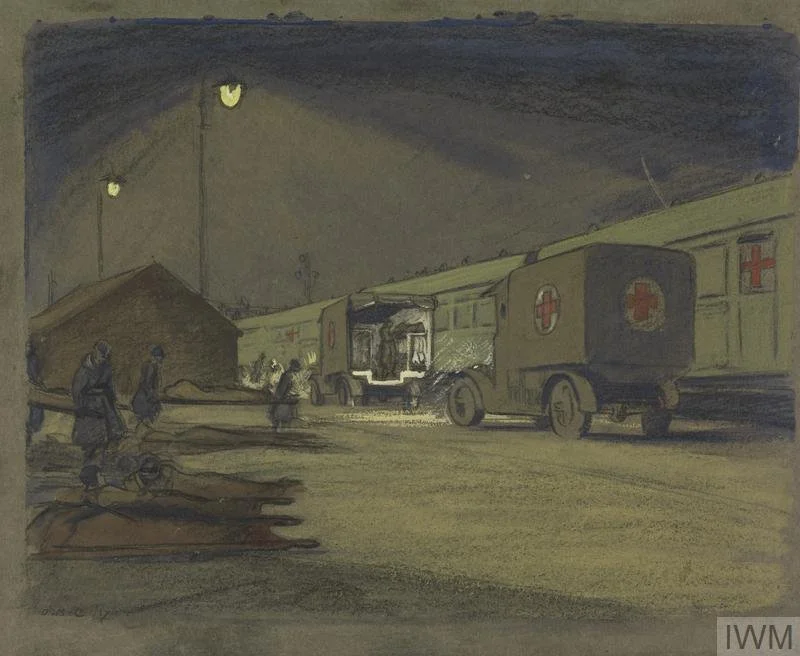
I’m pretty sure a Royal Artillery major called Gerard Harrington-Sykes didn’t visit a base hospital in Etaples one foggy night in March 1918 - but he could have done. Everything about him fits (his background, his service) and the circumstances are entirely plausible; the front line casualty clearing stations were overwhelmed during the final German offensive and the wounded were trained straight to the coast. It’s just that nobody logged his name - because, after a brief conversation with the woman he loved, he left without having his wound treated. Nurse Hathaway certainly wasn’t going to put that in her night report.
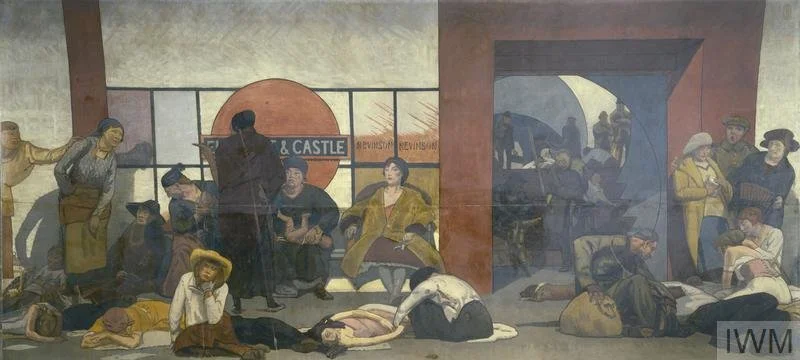
IMAGES from top: The Underworld: Taking cover in a Tube Station during a London air raid, Walter Bayes, 1918 © IWM (Art.IWM ART 935). Etaples Hospital Siding : a VAD convoy unloading an ambulance train at night, Olive Mudie-Cooke, 1917 © IWM (Art.IWM ART 3089).